Toxic Visibility in Q3 2025: As Investment Pours In, Women's Sports Face a Structural Abuse Crisis, Marked by Extreme Volatility
Q3 2025 Areto Hate Speech Index Analysis
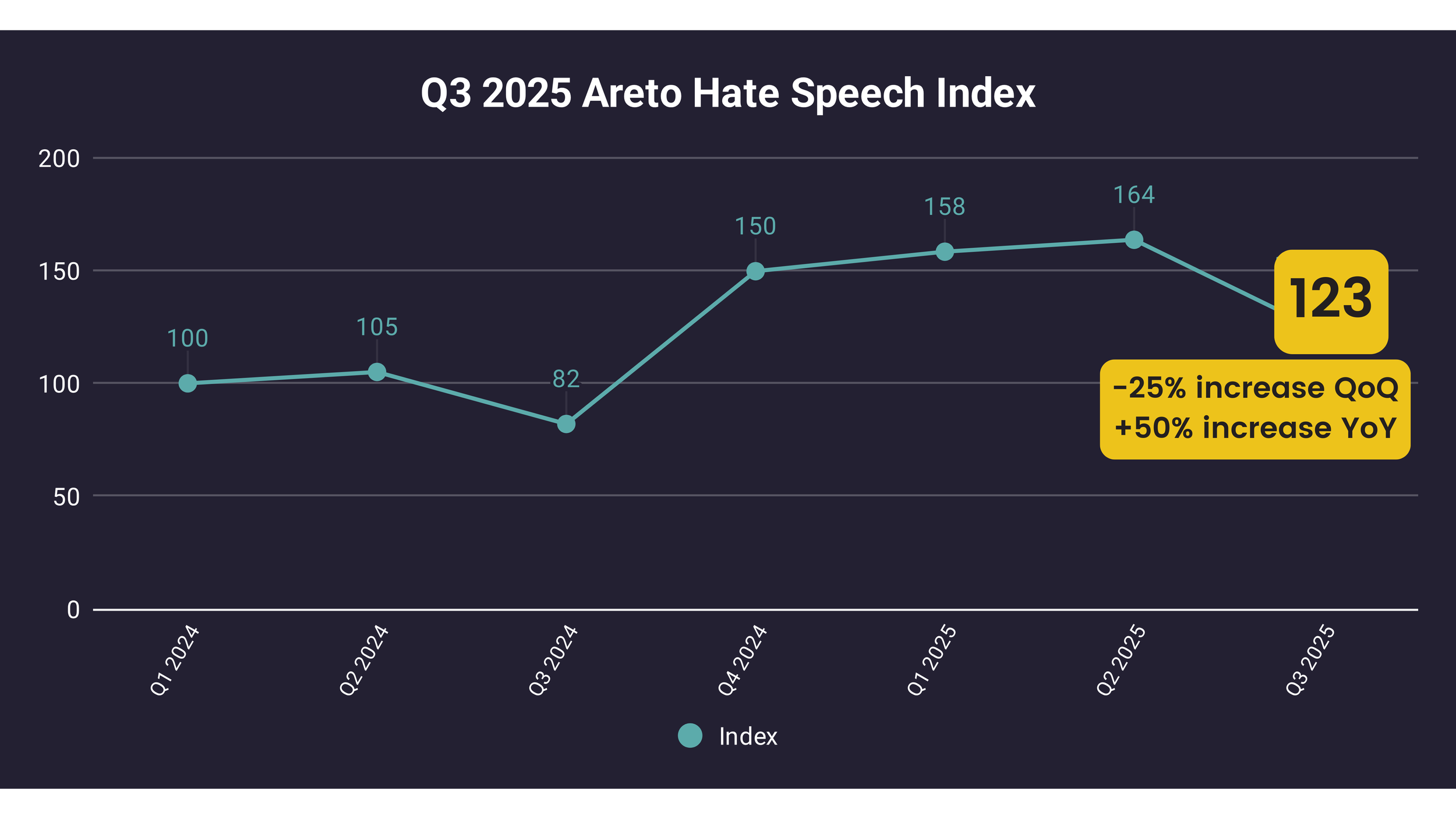
The Q3 2025 Areto Hate Speech Index confirms a sustained and rapidly escalating rise in hostility within online sports discourse, reflected by a 50% year-on-year (YoY) increase in the measure of overall toxicity. Despite a seasonal dip in the overall Index value, this increase is primarily driven by a disturbing surge in hostile and identity-based abuse, with Transphobia rising +103% YoY, Sexism +75% YoY, and hostility targeting Men's Sports surging +70% YoY.
The Q3 2025 Areto Hate Speech Index confirms a sustained rise in hostility within online sports discourse, reflected by a 50% year-on-year (YoY) increase in the measure of overall toxicity.
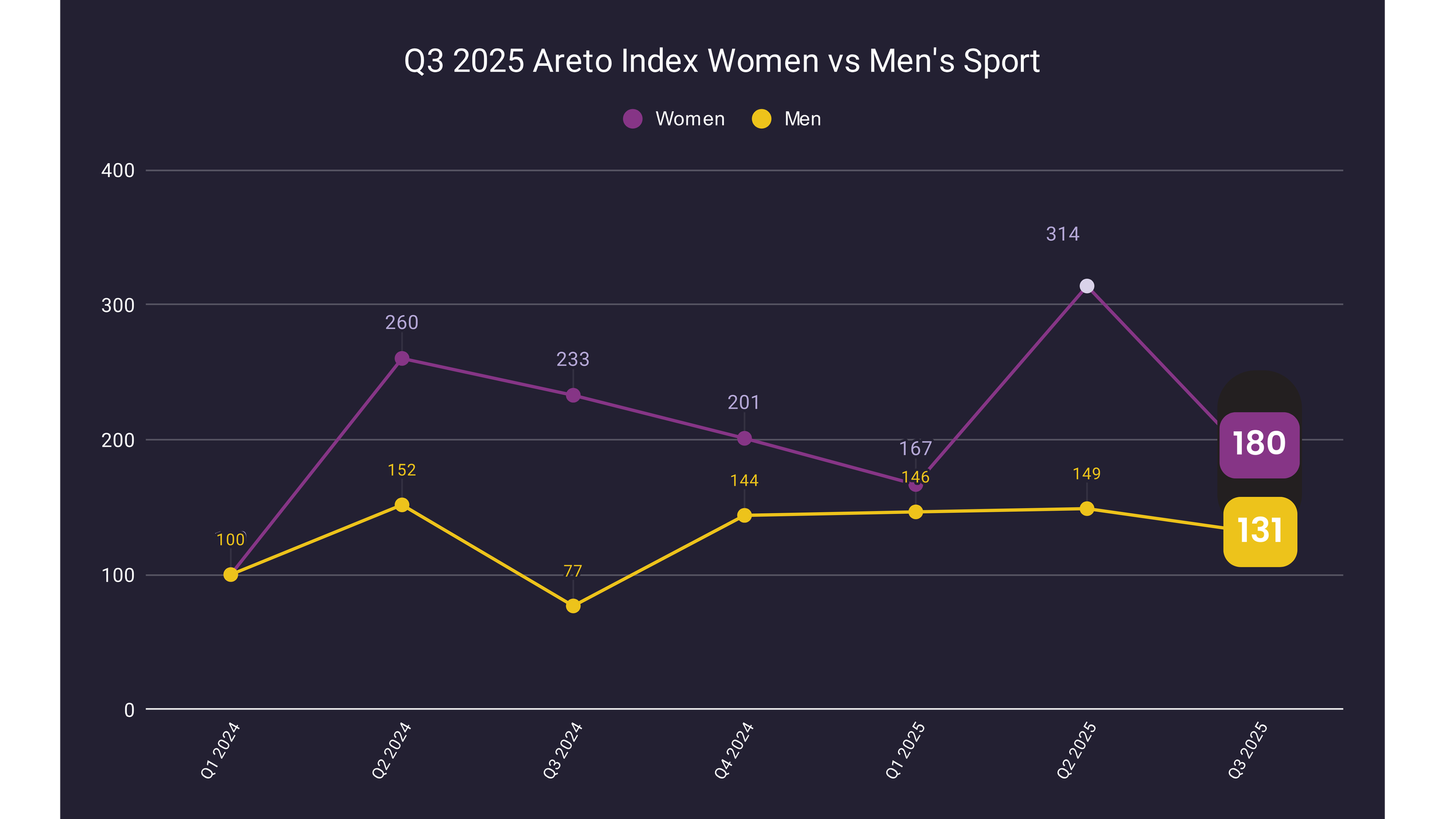
Despite a seasonal dip in this overall toxicity, the Index confirms a disturbing surge in structural, identity-based abuse across online sporting spaces. The crisis is acutely gendered: in the previous quarter, the Areto Index for women's sports toxicity was 32% higher than for men's sports (180 vs 131).
Q3 2025 Index Overview
| Category | Q3 2025 Index | QoQ Change | YoY Change |
|---|---|---|---|
| Overall | 123 | –25% | +50% |
| Women’s Sports | 180 | –43% | –23% |
| Men’s Sports | 131 | –12% | +70% |
| Racism | 45 | –46% | –50% |
| Sexism | 140 | –53% | +75% |
| Homophobia | 39 | –69% | –36% |
| Transphobia | 67 | –91% | +103% |
For women's sports specifically, the Q3 Index value of 180 reflects a −22.7% decline YoY—a seasonal reprieve that cannot obscure the structurally elevated crisis defined by the extreme volatility and growth seen in earlier quarters (e.g., +67% YoY in Q1 2025).
The key finding is that sexist and transphobic language is becoming normalized hostile discourse. While investment pours into women's sports, they continue to face disproportionately high levels of this toxicity.
Key takeaway: The normalization of hate
The overall Index fell, primarily due to the quieter summer sports schedule (the "Q3 Dip"). However, this masks alarming Year-over-Year (YoY) growth in normalized hostile language.
Women vs Men: Disproportionate Abuse and Volatility
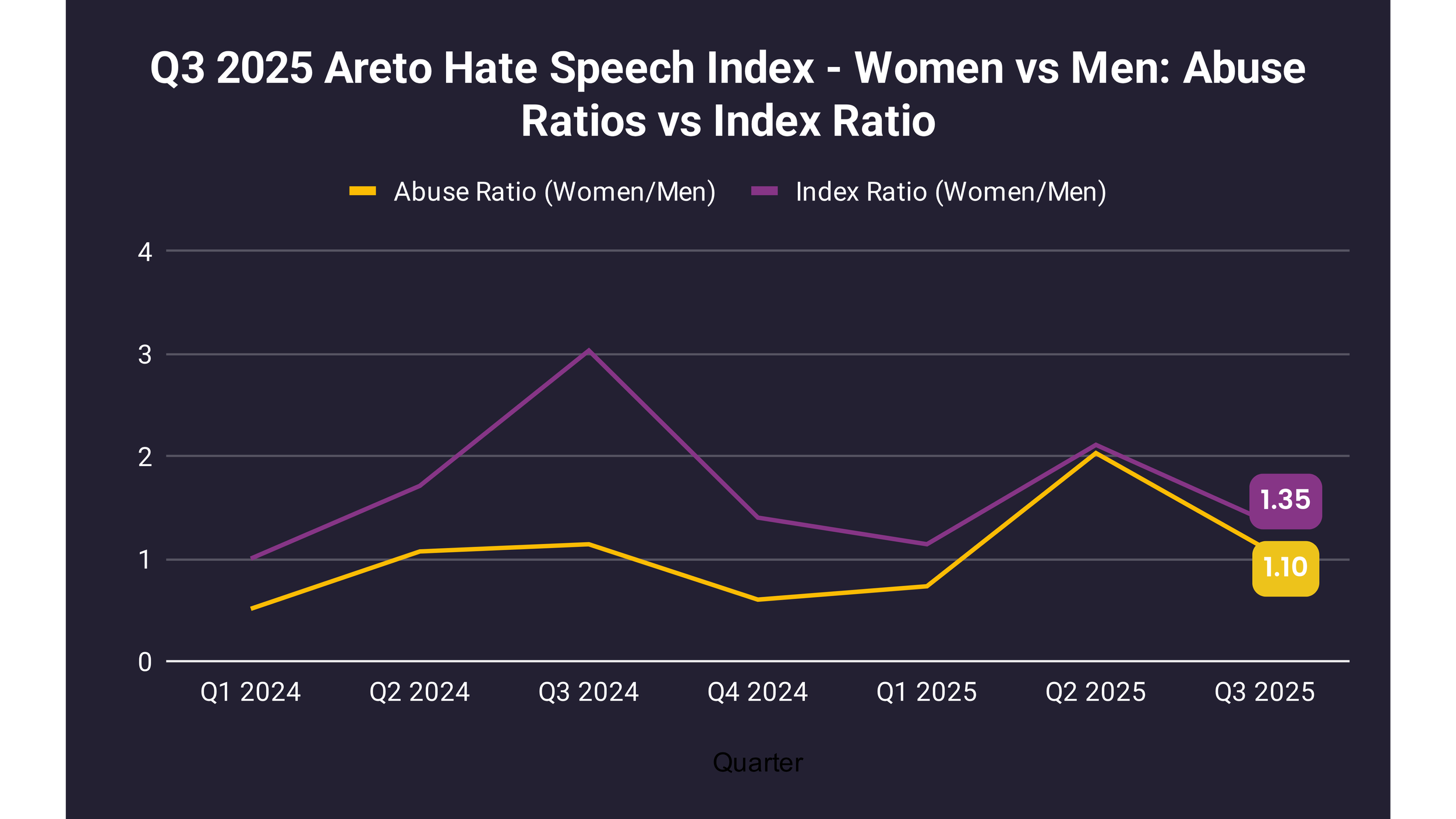
Even with a seasonal dip in Q3 2025, women’s sports continue to face structurally higher and more volatile abuse than men’s. Weighted and index ratios reveal that extreme abuse disproportionately targets women, with spikes often coinciding with high-visibility periods.
Women/Men Abuse & Index Ratios Over Time
| Quarter | Abuse Ratio (Women/Men) | Index Ratio (Women/Men) | Notes |
|---|---|---|---|
| Q1 2024 | 0.51 | 1.00 | Baseline |
| Q2 2024 | 1.07 | 1.71 | Early volatility |
| Q3 2024 | 1.14 | 3.03 | Spike during major events |
| Q4 2024 | 0.60 | 1.40 | Seasonal dip |
| Q1 2025 | 0.73 | 1.14 | Stabilization |
| Q2 2025 | 2.03 | 2.11 | Severe abuse peak |
| Q3 2025 | 1.10 | 1.37 | Seasonal dip, structural risk persists |
Key Takeaways:
Volatility matters: Women’s sports experience “bumpy” swings, unlike the smoother trends in men’s sports.
Structural disparity persists: Even when overall abuse dips, extreme abuse remains disproportionately high for women.
Normalized hostility is rising: Weighted and index ratios highlight the systemic nature of the problem, which seasonal trends alone would obscure.
The Growth of Normalized Hostility: Sexism and Transphobia
Persistent Normalization: Transphobia Doubling YoY
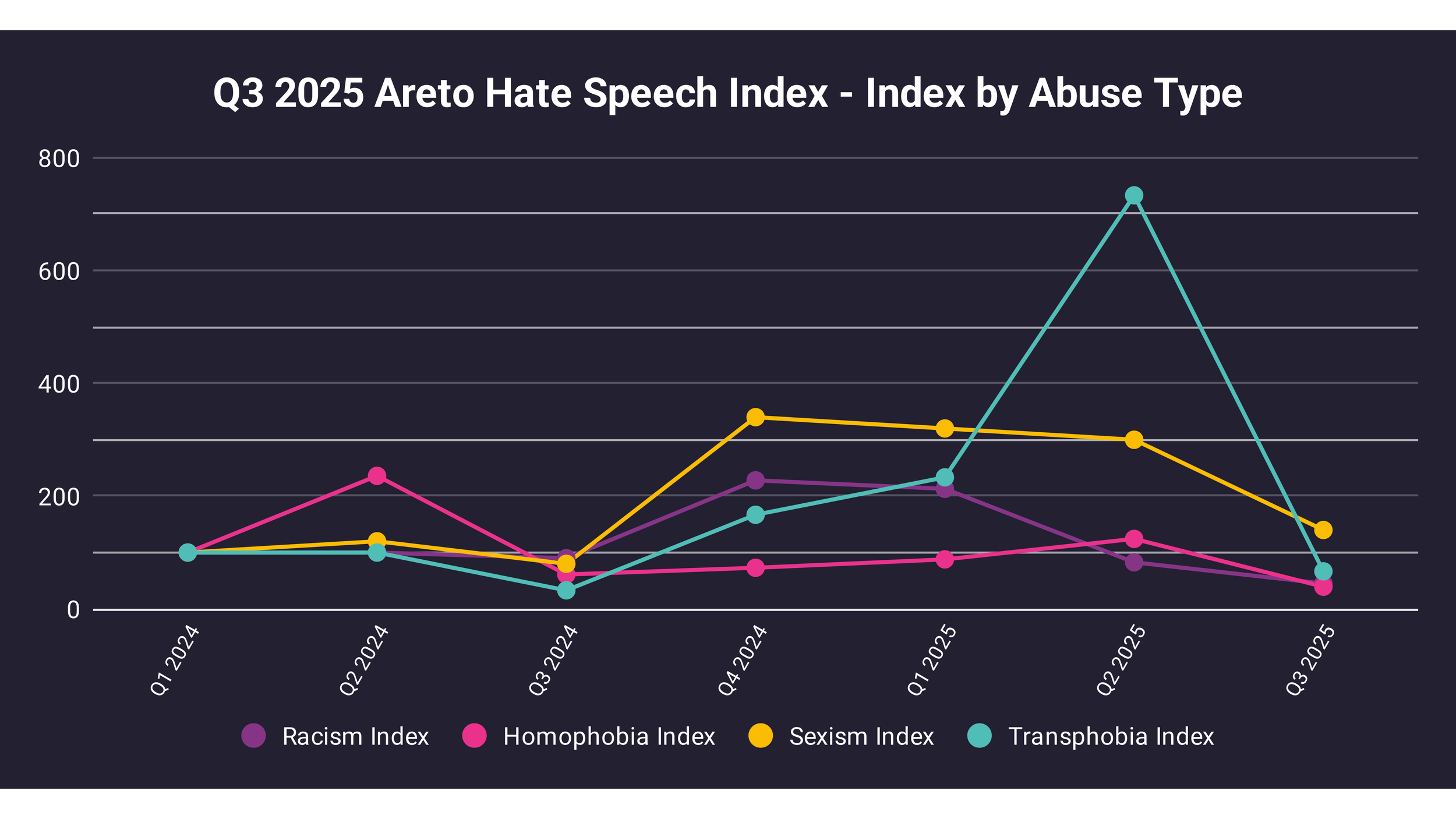
The Transphobia Index dropped seasonally to 67 in Q3 2025 (a −91% QoQ decline from the Q2 peak). Despite this, the +103% YoY growth demonstrates the critical structural takeaway: anti-trans rhetoric is no longer just tied to specific events or targeted attacks. It is increasingly used as normalized hostile vocabulary in general sports conversation. This persistent presence of exclusionary language across leagues and contexts reinforces the signal of who "belongs" in the sporting culture.
Transphobia Index Over Time
| Quarter | Transphobia Index | QoQ Change (%) | YoY Change (%) |
|---|---|---|---|
| Q1 2024 | 100 | — | — |
| Q2 2024 | 100 | 0% | — |
| Q3 2024 | 33 | -67% | — |
| Q4 2024 | 167 | +406% | — |
| Q1 2025 | 233 | +40% | +133% |
| Q2 2025 | 733 | +215% | +633% |
| Q3 2025 | 67 | -91% | +103% |
Structural Hostility: Sexism is Entrenched Discourse
The Sexism Index reached 140 in Q3 2025, showing a seasonal drop of −53% QoQ but remaining +75% higher YoY. Hostile language toward women is structurally entrenched, appearing as normalized antagonistic discourse across all sports. This language is frequently deployed to criticize performance or express generalized anger, affecting the discourse even when female athletes are not the direct targets. Sexism remains one of the most common ways antagonism manifests online, highlighting deeply ingrained attitudes.
Sexism Index Over Time
| Quarter | Sexism Index | QoQ Change (%) | YoY Change (%) |
|---|---|---|---|
| Q1 2024 | 100 | — | — |
| Q2 2024 | 120 | +20% | — |
| Q3 2024 | 80 | -33% | — |
| Q4 2024 | 340 | +325% | — |
| Q1 2025 | 320 | -6% | +220% |
| Q2 2025 | 300 | -6% | +150% |
| Q3 2025 | 140 | -7% | +75% |
The Escalation of Hostility: No Sports Are Immune
The persistent gap confirms that women's sports face structurally higher abuse, but normalized hostile language is pervasive across the board. The rise in hostility is Universal: While women's sports still face structurally higher identity-based abuse (Index 180), the Men’s Sports Index surged +70% YoY, confirming that generalized hostility is not confined to one gender but is rapidly escalating and pervasive across the entire sporting landscape.
This table provides a clear comparison of trends over the past seven quarters:
Women’s and Men’s Sports Index Over Time
| Quarter | Women’s Sports Index | Men’s Sports Index | Women’s Index YoY Change | Men’s Index YoY Change |
|---|---|---|---|---|
| Q1 2024 | 100 | 100 | — | — |
| Q2 2024 | 260 | 152 | — | — |
| Q3 2024 | 233 | 77 | — | — |
| Q4 2024 | 201 | 144 | — | — |
| Q1 2025 | 167 | 146 | +67% | +46% |
| Q2 2025 | 314 | 149 | +21% | -2% |
| Q3 2025 | 180 | 131 | -23% | +70% |
Sport-Specific Trends: Defining the Normal
Structural targeting is visible across all sports, but the nature of the hostility varies significantly. By analyzing Quarter-over-Quarter (QoQ) changes, we reveal the difference between volatile, event-driven abuse ("Bumpy") and steady, normalized antagonism ("Smooth").
Sports Index & Volatility (Q1–Q3 2025)
| Sport | Q1 2025 Index | Q2 2025 Index | Q3 2025 Index | Max QoQ Volatility* | YoY Change (Q3 '25) | Volatility Type |
|---|---|---|---|---|---|---|
| Women’s Basketball | 100 | 374.4 | 167.7 | +274%/−55% | +68% | BUMPY |
| Men’s Basketball | 100 | 121.9 | 115.1 | +22%/−6% | +15% | SMOOTH |
| Women’s Football | 100 | 55.0 | 69.7 | −45%/+27% | −30% | BUMPY |
| Men’s Football | 100 | 104.2 | 81.9 | +4%/−21% | −18% | SMOOTH |
*Max QoQ Volatility shows the magnitude of the largest increase (Q2 from Q1) and the largest decrease (Q3 from Q2) in the data set.
Insight: Women's sports experience massive, volatile BUMPY shifts (e.g., Women’s Basketball at +274% QoQ), often tied to periods of high visibility. Men's sports show a SMOOTHER pattern with small, persistent increases and slower drops, confirming the presence of a stable, normalized baseline of structural hostility across all sports.
Conclusion
The Q3 2025 Index is a clear warning that hostility is escalating universally. The structural surge is confirmed by massive YoY increases in Transphobia (+103%), Sexism (+75%), and generalized hostility targeting Men's Sports (+70%). This proves that normalized identity-based hostility is rapidly becoming the new standard, particularly and disproportionately affecting women, but the general rise in abuse is pervasive across all online sporting spaces.
This persistent and structural nature of abuse demands a fundamental shift in strategy. Platforms, leagues, and policymakers must pivot their focus from reactionary moderation to targeted, proactive interventions that disrupt the normalization and structural use of identity-based hostility online.
👀 Want to know your Index score?
The Areto Hate Speech Index measures abuse. Areto Content Moderation Software stops it in its tracks.
Contact us or sign up for a free 2-week trial
Methodology
What is Hate Speech? Areto's Hate Speech Index encompasses both illegal speech (such as threats or incitement to violence) and harmful speech that, while not necessarily illegal, creates an environment where individuals feel unsafe or unwelcome—ultimately leading them to disengage or leave the digital community.
How is the Index calculated? The Areto Index measures the percentage of abusive content by dividing the total number of abusive comments by the total number of comments analyzed across all accounts. This gives us a standardized way to track the volume of harmful content relative to overall engagement.
How was the Index benchmarked? The Index is based on 10 million real-world social media comments from 44 sports leagues and club ecosystems across North America, Europe, New Zealand and Australia. This includes a wide range of teams, leagues, and governing bodies—providing a global benchmark for online abuse in sport.